Short answer: Yes on independent lab testing and on the newer power floor. A Jinko solar panels review that follows Kiwa PVEL and the written US warranty lands there, with two limits: most current US models carry a 12-year product warranty, and Jinko reported a US$635.6 million net loss for FY2025.
Updated: November 2026
Who writes this reference, and how a claim gets sourced, is on the about page.
The short version
- Kiwa PVEL lists Jinko as a Top Performer in 2014 and in every edition from 2016 through 2026.
- V6.0 puts the G6 54-cell black and the G7 at 87.40% of nameplate in year 30.
- Product warranty on most current US models: 12 years. The 25-year product term is the G6 54-cell black.
- FY2025 net loss: US$635.6 million. Gross margin: 2.2%, against 10.9% in FY2024.
- Bifacial power coverage: front side only.
Jinko solar panels review scorecard: how Jinko rates on five criteria
Jinko rates strong on the published reliability tests and on the G6/G7 degradation floor. The latest full year fails a profitability test, and three of the four current US datasheets carry a 12-year product term.
| Criterion | Evidence | Source | Verdict |
|---|---|---|---|
| Independent testing | Top Performer in 2014 and every year from 2016 to 2026. All seven categories in the 2025 scorecard. Seven tests in 2026; UVID not among them. | Kiwa PVEL scorecard | Strong, for the bills of materials tested |
| Degradation guarantee vs the NREL median | G6 54-cell black and G7: 1% in year 1, then 0.4%/yr, 87.40% at year 30. Median of reported field rates: 0.5%/yr. | V6.0 warranty; Jordan and Kurtz, NREL, 2012 | Higher year-30 floor than a flat 0.5%/yr line, on those terms |
| Product warranty length | 25 years only on the G6 54-cell black. 12 years on G7 and on other module types. | V6.0, for sales on or after January 1, 2025 | 12 years unless the module is that G6 |
| Financial strength | FY2025 revenue US$9.37 billion (down 29.0%), gross margin 2.2%, net loss US$635.6 million. | FY2025 results release, April 16, 2026 | Loss-making in the latest full year |
| US presence | NYSE since 2010. Manufacturing listed in Florida, Malaysia and Vietnam. Warehouses in Long Beach CA, Houston TX, Port Elizabeth NJ and Jacksonville FL. 75.1% of the Jacksonville plant sold, as reported by PV Tech in May 2026. | Jinko US site, seen November 24, 2026; PV Tech, May 11, 2026 | Stocked in the US. Florida plant is a minority stake. |
The grade changes if your part number is an older generation, or if the sale date sits outside V6.0. Read the label before you borrow the G6 number.
How did Jinko do in Kiwa PVEL testing?
Jinko appears on the Kiwa PVEL reliability scorecard in 2014 and in every edition from 2016 through 2026. That run is the strongest independent evidence in this review.
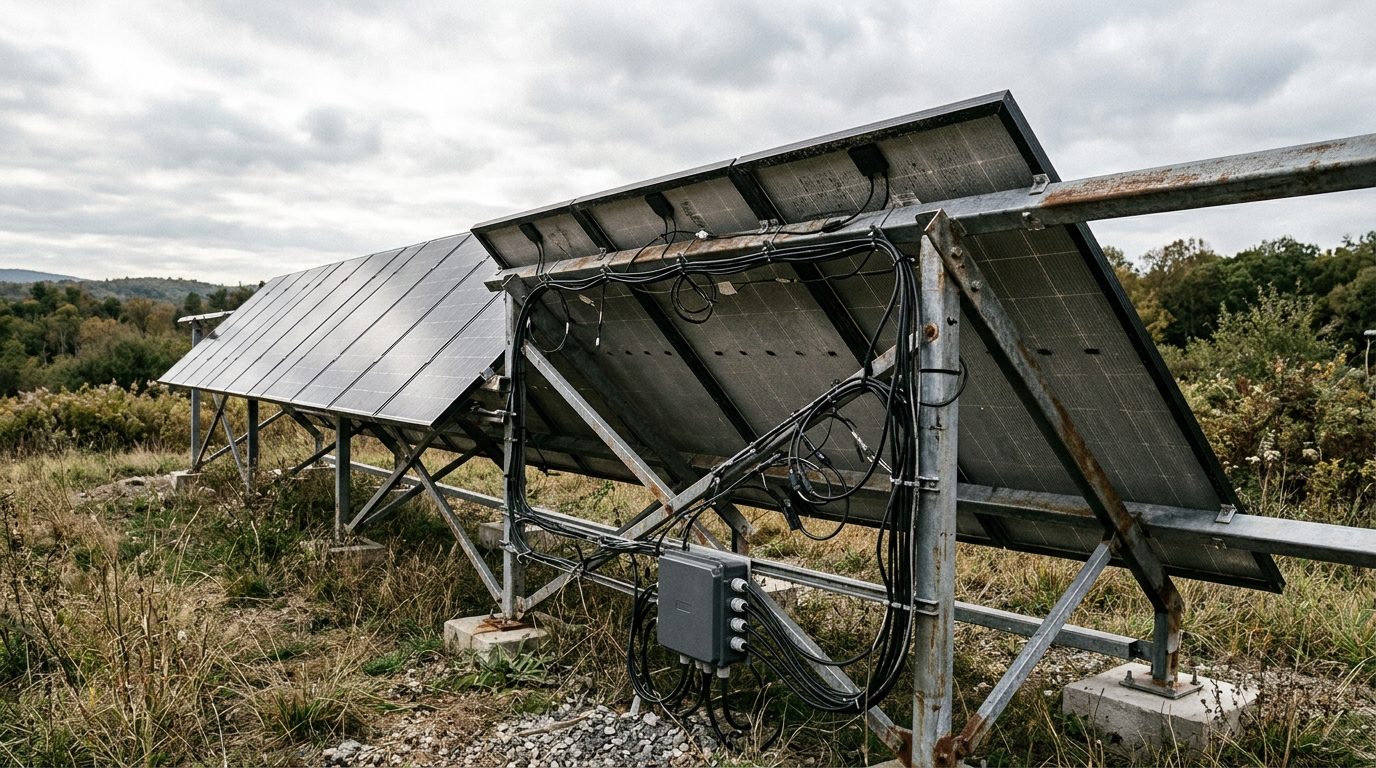
Jinko’s June 4, 2025 release says the 2025 scorecard named Jinko a Top Performer in all seven reliability categories, for the 11th consecutive edition, and that Jinko was one of only two manufacturers with that record. The same release says the EAGLE G6X withstood 55 mm hailstones in the Hail Stress Sequence. It quotes Kiwa PVEL VP Tristan Erion-Lorico: “Congratulations to JinkoSolar for achieving Top Performer status across all seven reliability tests in our Scorecard”.
The 2026 Kiwa PVEL manufacturer page lists Jinko under Top Performers in 7 tests: thermal cycling (TC), damp heat (DH), mechanical stress sequence (MSS), hail stress sequence (HSS), potential-induced degradation (PID), LID+LETID, and PAN. UVID is not on Jinko’s list. Top Performer means those named tests, on the bills of materials Kiwa ran.
pv magazine USA, writing up the scorecard on May 27, 2026, reported a hard year across the industry. 87% of manufacturers had at least one test failure, a record for the scorecard, and 43 manufacturers still qualified as Top Performers. 45% of manufacturers had at least one major delamination failure. 26% of bills of materials broke during load testing. No single bill of materials earned Top Performer on all tests, a first in the scorecard’s 12-year history. A Jinko line on that page is a BOM result. It does not travel automatically to every pallet with a Jinko label.
Keep the hail numbers attached to the document that printed them. Jinko’s 2025 release says the EAGLE G6X withstood 55 mm hailstones in the Hail Stress Sequence. The G6X datasheet says the module was tested against hail up to 55 mm, a 55 mm hailstone at 33.9 m/s. The G6X product page lists 6000 Pa front and 5400 Pa rear, calls the glass EAGLE Talon Glass, describes the 55 mm hail figure as UL certified, and calls the module a PVEL 2024 Top Performer for hail stress. The product-page lines are Jinko’s. The scorecard is the independent record.
Is Jinko a Tier 1 manufacturer?
Jinko’s US home page, seen November 24, 2026, says the company is a Bloomberg Tier 1 manufacturer and that one in eight modules worldwide was produced by Jinko. Both sentences are Jinko’s.
A volume line tells you how many modules Jinko says it has shipped. The Kiwa PVEL list is the lab record. Use the scorecard for damp heat, thermal cycling, hail and the other named tests. The datasheet and V6.0 do not spell out Bloomberg’s rules for the Tier 1 label. The home page also says Jinko has been on the New York Stock Exchange since 2010. A listing is a corporate fact the site states. It is a separate question from how a module scored.
How long do Jinko solar panels last?
An EAGLE module that V6.0 treats as G6 54-cell black or as G7 is guaranteed at least 87.40% of rated power at year 30. That percentage is the figure hiding inside a quote that only says “30-year warranty.”
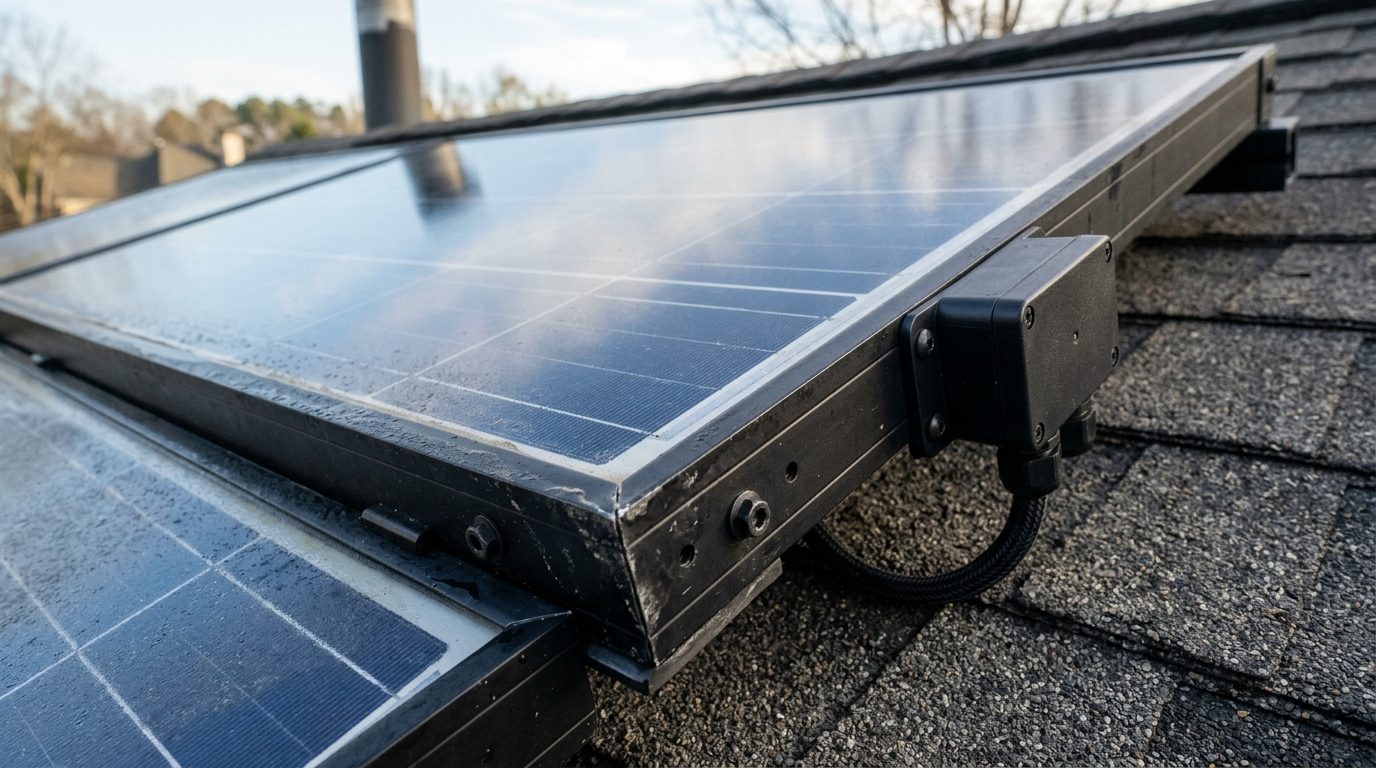
Work it for the top residential bin, the EAGLE G6R at 440 W, part number JKM420-440N-54HL4-B-R. The G6R datasheet caps loss at 1% in year 1 and 0.4% each year after. V6.0 prints the same schedule for the G6 54-cell black and for G7.
Year 1 takes 1.0%. The next 29 years take 0.4% each, which is 11.6%. The warranty allows 12.6% loss in total. What remains is 87.4% of nameplate, the same 87.40% V6.0 prints. On a 440 W STC rating, 87.4% is 384.6 W, because 440 × 0.874 = 384.56.
That 384.6 W is a share of the nameplate rating under the warranty’s own math. Roof temperature, soiling and the inverter sit outside the percentage.
The field benchmark is older. D. C. Jordan and S. R. Kurtz, in a 2012 NREL review of nearly 2,000 reported photovoltaic degradation rates, found a median of 0.5% per year. Lay that median flat for 30 years and the loss is 15% (0.5 × 30), so the straight-line remainder is 85%. The G6/G7 floor of 87.4% at year 30 sits above that line. Two conditions belong with the comparison. The median comes from older technology, and it is field data, not a contract. The flat 30-year product is a reading of the 0.5% figure. The paper did not publish an 85% year-30 remainder.
The guaranteed share has risen across the generations V6.0 lists, for modules that document covers:
| Generation | Power term ends | Guaranteed share of nameplate |
|---|---|---|
| G2 monofacial black | Year 25 | 83.1% |
| G4 66-cell black | Year 25 | 84.80% |
| G5b bifacial | Year 30 | 84.95% |
| G6 54-cell black and G7 | Year 30 | 87.40% |
A G2 promise of 83.1% at year 25 is a lower floor, and it ends five years sooner. Match the generation on the label to the row before you compare quotes.
Two current 72-cell datasheets sit beside that table. The G6B datasheet (JKM580-600N-72HL4-BDV) states no more than 1% in year 1, 0.4% per year after, and at least 87.4% at year 30. The G6X datasheet (JKM580-600N-72HL4-BDX) states no more than 1% in year 1, 0.44% per year after, and at least 87.44% at year 30. The G6X sheet does not show the arithmetic between 0.44% and 87.44%. For a G6X label, keep the datasheet floor next to the warranty that matches the sale date.
On JKM420-440N-54HL4-B-R, the datasheet supports this much of a decode. The 420-440 band is wattage, in 5 W steps. N is the N-type cell. The 54 in the code is 108 half cells, laid out 6×18. The product page describes a black frame and backsheet. The datasheet does not define each letter in the suffix HL4-B-R. Module efficiency on that sheet runs from 21.51% at 420 W to 22.53% at 440 W. Temperature coefficient of Pmax is −0.29%/°C. Fire Type is 1. Maximum system voltage is 1000 VDC.
What does the Jinko US warranty really cover: 12 or 25 years?
Twelve years is the product warranty on the current large US modules. Twenty-five years is the product warranty V6.0 gives the G6 54-cell black, which is also what the G6R datasheet prints. Power coverage on those G6 and G7 terms runs 30 years. The two clocks measure different failures. A cracked frame is a product claim. Output below the floor is a power claim.
The Authorized Distributor Limited Warranty V6.0 covers modules Jinko sold to an Authorized Distributor on or after January 1, 2025. Inside it, G7 is 12 years product and 30 years power, at 1.0% then 0.40% per year, with 87.40% at year 30. G6 54-cell black is 25 years product and 30 years power, on the same degradation schedule. Other module types get a 12-year product warranty. The G7B, G6X and G6B datasheets each print 12 years product and 30 years power.
The G6R product page conflicts with both the datasheet and V6.0. Seen November 24, 2026, that page lists a 12-year product warranty and a 30-year linear power warranty for a module whose black frame and backsheet it calls ideal for residential applications, with a black frame and backsheet, Fire Type 1, 3.2 mm front glass and a twin array design for partial shading. For the 54-cell black G6, go by V6.0 and the datasheet. Ask for the PDF with the quote.
The sale path is part of coverage. V6.0 applies when you buy through a listed Authorized Distributor, or through a residential installer that buys directly from Jinko under these terms.
What voids a Jinko solar panel warranty?
V6.0 is specific about how coverage ends. These are the exclusions and conditions V6.0 sets out.
- The module was not bought through an Authorized Distributor, or through a residential installer that buys directly from Jinko under V6.0.
- The modules were removed and reinstalled at another location.
- Installation did not follow the Jinko Installation Manual.
- The module was altered or repaired without approval.
- The claim notice missed its window: 30 days from when you learned of a suspected breach, by email to Jinko US customer service.
The clock starts on the Warranty Start Date, which is 180 days after manufacture. Manufacture is digits 7–12 of the serial number, read as YYMMDD.
Here is the rule on a made-up digit string, so you can see the count. Digits 7–12 read 250314. That is a manufacture date of March 14, 2025. Add 180 days and the Warranty Start Date is September 10, 2025. Count the 12-year or 25-year product term, and the 30-year power term, from that September date. Check the suffix on the part number. Then read those six digits before you argue a start date with a seller.
On bifacial modules, the power warranty covers front-side output only. The G6B, G6X and G7B datasheets list a bifacial factor of 80±5%. That factor is a spec on the sheet. V6.0 does not pay the power claim on rear-side watts.
Is Jinko Solar financially stable enough to stand behind a 30-year warranty?
Jinko lost US$635.6 million in FY2025, attributable to ordinary shareholders, in the results release dated April 16, 2026. Revenue was US$9.37 billion, down 29.0% from the year before. Gross margin was 2.2%, against 10.9% in FY2024. The power warranty you are reading can run 30 years. The latest full-year margin was just over two cents of gross profit on a dollar of revenue.
Module shipments in that release were 86,056 MW, down 7.3% year over year. A later Jinko release, May 8, 2026, cites the 2025 annual report and says 86.8 GW shipped in 2025. Both numbers come from Jinko. They do not match. Use 86,056 MW when you are quoting the FY2025 results release. Use 86.8 GW when you are quoting the annual-report line.
The scale figures are Jinko’s as well. The April release says Jinko was the first manufacturer to deliver over 390 GW of modules in total, with Tiger Neo series shipments above 220 GW, and it gives 2026 module shipment guidance of 75–85 GW. Guidance is a company target, not a result. The May release says cumulative shipments were above 400 GW by the end of Q1 2026, and it claims global sales leadership for the seventh time. The ranking body is not named. Count the seventh-time line as Jinko’s own claim. Scorecard editions, quarterly results and the plant sale are followed on the news page.
The US site says Jinko has been listed on the New York Stock Exchange since 2010. It still lists manufacturing in Florida, Malaysia and Vietnam, and the four warehouses named in the scorecard. As reported in May 2026, Jinko sold 75.1% of Jinko Solar (US) Industries, the 2 GW module plant in Jacksonville, to FH Capital, and kept 24.9%. PV Tech reported that sale on May 11, 2026. FH Capital plans to at least double module capacity and to start US battery energy storage manufacturing. A “made in Florida” line means a plant Jinko now holds at 24.9%, when the module was built there. Malaysia and Vietnam remain on the US site’s factory list.
The results release does not say Jinko has stopped honoring warranties. A 30-year term still has to be collected from a listed manufacturer that lost US$635.6 million in its latest reported year. If you need that year to have been profitable, this record fails the test. If you need a written floor plus the lab history, use V6.0 and the Kiwa PVEL list, and keep the loss in view while you do.
Which Jinko panels can US buyers get?
Current US datasheets are EAGLE modules, not Tiger Neo. The Jinko US download center, seen November 24, 2026, lists four solar datasheets: EAGLE G7B (615–640 W), G6X (580–600 W), G6B (580–600 W) and G6R (420–440 W).
The residential-roof option in that set is the G6R, JKM420-440N-54HL4-B-R: 420–440 W, 21.51% to 22.53% module efficiency, 108 half cells, black frame and backsheet, Fire Type 1. G7B (JKM615-640N-66HL4M-BDV) is 615–640 W, 22.77% to 23.69%, N-type TOPCon, 132 half cells, bifacial. G6X (JKM580-600N-72HL4-BDX) and G6B (JKM580-600N-72HL4-BDV) are 580–600 W and 22.45% to 23.23%, with 144 half cells and the same 80±5% bifacial factor. On these codes the digits after JKM are the wattage band, N is the N-type cell, and 54, 66 or 72 is the count the datasheet builds as half cells. The datasheets do not define the trailing letters one by one.
G7B, G6X and G6B are 1500 VDC modules with a 12-year product warranty on the datasheet. More Jinko reference pages are on the Jinko solar panels home page.
Tiger Neo 3.0, on Jinko’s global site, is a different module: 670 W at 24.8% module efficiency, a temperature coefficient of −0.26%/°C, and bifaciality of 85±5%. That page does not state the warranty years. A Tiger Neo review does not map onto a US EAGLE quote. Where the current US datasheets state a Pmax temperature coefficient, it is −0.29%/°C.
Jinko’s EAGLE modules page says the G6 and G7 use its latest TOPCon cells, with cell efficiencies over 26%. A May 8, 2026 Jinko release says N-type TOPCon cell efficiency reached 27.79%. Cell efficiency is not module efficiency. The highest module efficiency on a current US datasheet is 23.69%, on the 640 W G7B. The G6R and G6B datasheets say N-type mono. The G6X and G7B datasheets say N-type TOPCon.
Who should buy Jinko panels, and who should look elsewhere?
Buy Jinko if you want the long Kiwa PVEL Top Performer history, the 87.4% year-30 power floor on the G6 54-cell black and G7 terms in V6.0, and a black 54-cell residential module on a 25-year product term. That residential module is the G6R. The seller has to be an Authorized Distributor, or a residential installer buying directly from Jinko, on a sale V6.0 covers.
Look elsewhere if you need a 25-year product warranty on a large-format or bifacial module. G7B, G6X and G6B are 12 years on the product clock. Look elsewhere if the energy model counts rear-side gain as warrantied output, if you plan to remove the array and reinstall it at another site, or if the manufacturer’s latest reported year has to be profitable before you will accept a 30-year promise.
The federal Residential Clean Energy Credit equals 30% of the costs of new, qualified clean energy property. The IRS says the credit is not available for any property placed in service after December 31, 2025. That IRS page was last reviewed November 23, 2026. For an array placed in service after December 31, 2025, price and the warranty text are what the brand decision rests on.
Are Jinko panels made in China?
Jinko’s US site lists manufacturing in Florida, Malaysia and Vietnam. That page does not name a factory in China. The plant that built the module you are buying is a line on the label and the shipping paperwork.
Does the Jinko warranty cover bifacial rear output?
No. On bifacial modules, V6.0 limits the power warranty to front-side output.
How do I find my Jinko panel’s warranty start date?
V6.0 sets the Warranty Start Date at 180 days after manufacture, for modules the document covers. Read manufacture from digits 7–12 of the serial number, as YYMMDD, and add 180 days.
Is Jinko going out of business?
Jinko’s April 16, 2026 results release reports a FY2025 net loss of US$635.6 million and shipments of 86,056 MW. The US site describes a New York Stock Exchange listing since 2010. None of those documents announces that Jinko has stopped operating. The loss is large enough that the warranty PDF belongs in the file with the quote.
Check on your quote
Before you pay, verify the paperwork against the warranty, one line at a time.
- Match the JKM part number to the V6.0 generation: 25-year product term for the G6 54-cell black, 12-year product term for G7 and for other module types.
- Confirm the seller is an Authorized Distributor, or a residential installer that buys directly from Jinko, and that you are relying on V6.0 only for a sale on or after January 1, 2025.
- On a G6B, G6X or G7B, leave rear-side kilowatt-hours out of the warranty math.
- Read digits 7–12 of a serial as YYMMDD and add 180 days, so you know the day the term starts.
- On a G6R quote, set the product page’s 12-year line aside. The datasheet and V6.0 say 25 years product for that 54-cell black module.